


A Level Physics isn’t just a harder version of GCSE. The biggest challenge isn’t the maths - it’s learning how to apply physical principles to unfamiliar situations.
Students who do well usually build three habits early:
• Understand the “why” behind every equation instead of memorising it.
• Practise explaining concepts in words before solving calculations.
• Review mistakes regularly rather than simply completing more questions.
If you’re starting Year 12 this autumn, spending just a little time building these habits now can make the transition much smoother.
I’m always happy to answer questions about A Level Physics or help students prepare for the year ahead.
Right now many students are thinking:
“I revise for hours but still struggle with exam questions.”
“I understand the theory until I see a past paper.”
“The mark scheme feels impossible.”
“I keep losing marks in calculations and explanations.”
Here’s the reality:
A-Level Physics is not mainly testing memory.
It is testing whether you can:
- think logically,
- apply principles calmly,
- and communicate physics clearly under pressure.
Most students lose marks because:
- they rush algebra,
- skip units,
- misunderstand command words,
- or panic when questions look unfamiliar.
One of the highest-mark-loss topics every year is:
Electric Circuits
Example Question:
A resistor of 4 Ω carries a current of 3 A.
Find the potential difference across the resistor.
Formula:
V = IR
Step 1 — Substitute values
V = 3 × 4
Step 2 — Calculate
V = 12 V
Final Answer:
12 V
Simple question.
But many students still lose marks by:
- forgetting units,
- rearranging equations incorrectly,
- or copying numbers wrongly under pressure.
Now look at a more “A-Level style” extension:
A current increases from 2 A to 5 A while resistance remains constant.
What happens to potential difference?
Using:
V = IR
If R stays constant:
- increasing current increases voltage proportionally.
This is where strong students separate themselves:
not by memorising formulas,
but by understanding relationships.
Last 7-Day A-Level Physics Strategy
DO:
- Practice derivations and calculations daily
- Focus on definitions exactly as mark schemes expect
- Learn required practical methods
- Review mistakes from old papers
- Prioritise:
• Electricity
• Mechanics
• Particles & Radiation
• Waves
• Circular Motion
• Fields
DON’T:
- Memorise without solving questions
- Ignore units and significant figures
- Spend all day watching revision videos
- Panic if a question looks unfamiliar
Remember:
Difficult A-Level Physics questions are usually built from simple ideas combined together.
Break the problem down step-by-step.
Write clearly.
Show every stage of working.
Method marks can save grades.
You do not need perfection for an A or B.
You need consistency, structure, and calm thinking under pressure.
Good luck for A-Level Physics Paper 1.
Hi Everyone!
Most students are taught how to solve Physics problems…
but not how to think about them.
That’s why in exams:
- You forget steps
- You don’t know where to start
- You’re unsure which formula to use
In the next webinar, we’ll focus on:
- How to start any Physics problem
- How to decide which method to use
- Why formulas actually work
This will be much more about understanding than memorising.
If there’s a specific topic you’d like me to include, let me know below
They struggle because they don’t know how to think through a problem.
“I know the formula… but I don’t know when to use it”, this is where marks are lost.
The real issue?
- Students jump straight to formulas
- They skip identifying what’s actually given
- And that’s where confusion starts
Physics isn’t about memorizing equations.
It’s about structured problem-solving.
If you fix this one habit, performance changes fast.
I’m planning a live session where I’ll break this down using real exam questions - step by step.
Comment 👍 if you want to join.

When you’re solving a Physics problem, what do you struggle with most?
A) Not knowing which formula to use
B) Not knowing how to start
C) Getting stuck halfway
D) Understanding the concept itself
Be honest, this will really help shape the next session.
From what I’ve seen, most students don’t struggle because Physics is hard…
they struggle because no one shows them how to think through a problem.
I’m planning the next webinar around this, breaking things down step-by-step so you can approach any question with confidence.
Drop your answer (A/B/C/D) or comment your specific struggle
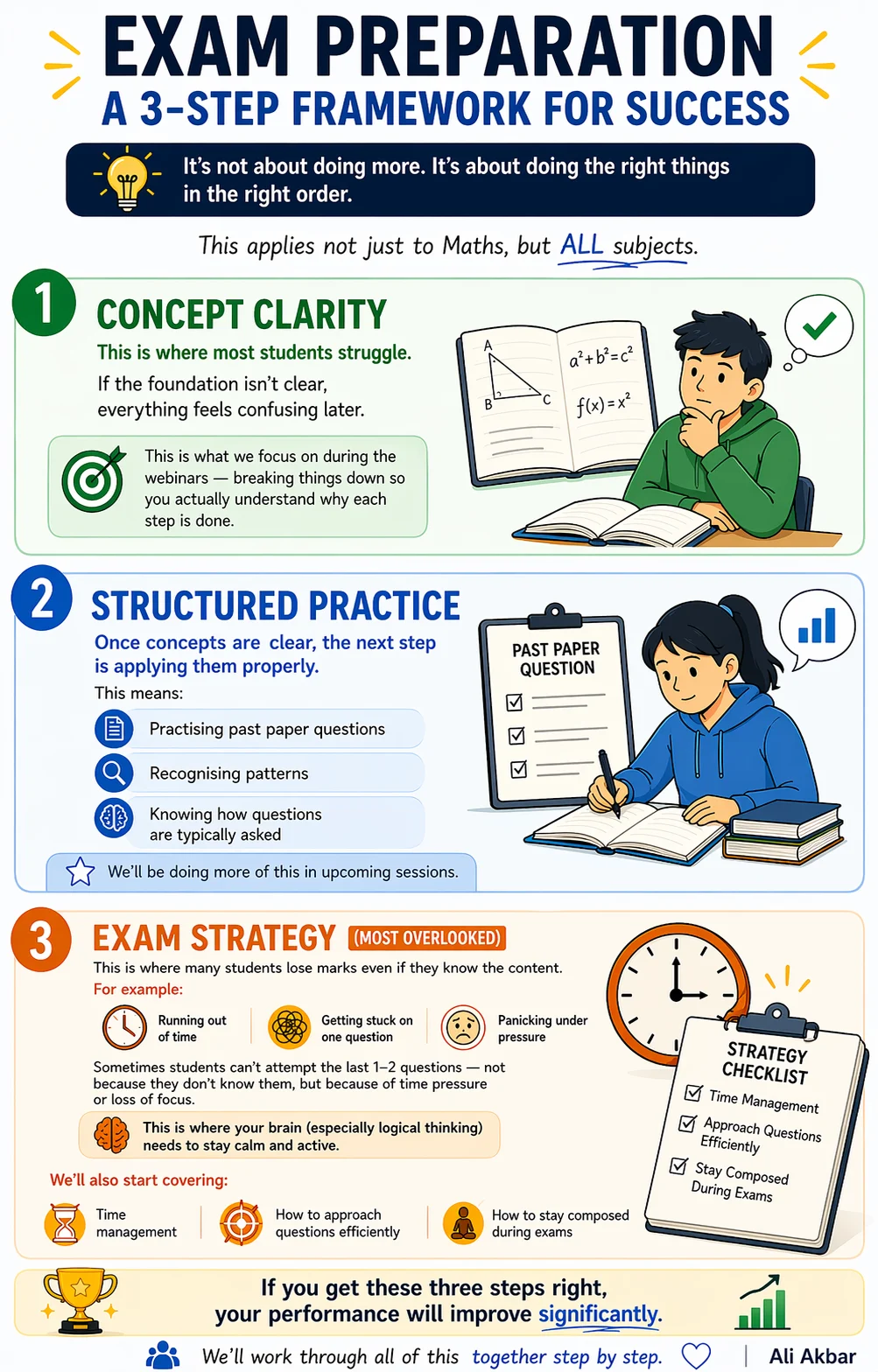
Success in exams isn’t about doing more, it’s about doing the right things in the right order.
This 3-step framework focuses on what truly drives performance:
- Building strong concept clarity as your foundation
- Reinforcing learning through structured practice
- Applying smart exam strategy under pressure
Many students know the content, but lose marks due to poor execution. The difference lies in preparation and approach.
Get these three right, and your performance won’t just improve, it will transform.
Let’s build this step by step.
I’ve seen a lot of students post tough Physics questions online and either:
- Get no response
- Get an answer with no explanation
- Get something overly complicated
Let’s work through it properly.
Challenge Question (Mechanics – Energy & Forces):
A particle of mass m is projected up a smooth incline with speed u.
It comes to rest after travelling a distance s.
Show that:
u² = 2gsinθ × s
Step-by-step thinking:
-
Forces acting along the slope:
- Weight component = mg sinθ (down the slope)
-
Acceleration:
- a = −g sinθ (negative because it slows down)
-
Use SUVAT:
v² = u² + 2as
At highest point: v = 0
0 = u² + 2(−g sinθ)s
⇒ u² = 2gsinθ × s
Key insight:
This links forces → acceleration → motion equations
(not just plugging into formulas blindly)
If you’ve got a Physics question (mechanics, electricity, fields, etc.), post it below
I’ll break it down clearly so it actually makes sense.
We’ll also be doing live sessions where I solve exam questions and explain the full reasoning.
Let’s make this the place where difficult questions finally get answered