


GCSE Physics rewards students who understand concepts rather than memorise facts.
Some topics that are worth revisiting before school starts include:
• Energy transfers
• Forces and motion
• Electricity basics
• Graph interpretation
• Scientific calculations
Starting with confidence in these core areas makes the rest of the course much easier.
I’m always happy to help students build a solid foundation before the academic year begins.
Huge well done to everyone who sat their GCSE Physics Paper 1 this morning!
Did the calculations treat you well, or did that 6-mark question catch you off guard? Let us know which exam board you sat (AQA, Edexcel, OCR) and how you think it went!
One Physics paper down, one more to go on June 15th. How many exams do you have left total?
Most students are not scared of Physics because it is “too hard”.
They struggle because:
- formulas feel disconnected,
- questions look unfamiliar,
- and mark schemes seem brutally specific.
Right now many students are thinking:
“I memorise formulas but forget when to use them.”
“I understand the lesson… until I see the exam question.”
“I lose marks even when my final answer is correct.”
“I panic when calculations appear.”
Here’s what most students don’t realise:
GCSE Physics is NOT mainly about intelligence.
It is about:
- clear method,
- unit awareness,
- and showing logical steps.
One of the most repeated Physics topics every year is:
Density
Example Question:
A metal block has:
- mass = 240 g
- volume = 30 cm³
Find the density.
Formula:
density = mass ÷ volume
Step 1 — Substitute carefully
density = 240 ÷ 30
Step 2 — Calculate
density = 8 g/cm³
Final Answer:
8 g/cm³
Where students lose marks:
- forgetting units,
- using the wrong formula,
- calculator mistakes,
- or not rearranging equations properly.
Another common exam trap:
Students memorise formulas without understanding what they mean.
For example:
speed = distance ÷ time
If speed increases:
- either distance becomes larger,
- or time becomes smaller.
That understanding helps with harder 4–6 mark questions.
Last 20-Day GCSE Physics Strategy
DO:
- Practice calculation questions daily
- Learn units with every formula
- Revise required practicals
- Use past paper mark schemes
- Focus on:
• Energy
• Electricity
• Density
• Forces
• Atomic structure
• Waves
DON’T:
- Only watch revision videos
- Memorise equations without practice
- Ignore command words like:
• Explain
• Describe
• Calculate
• Evaluate
Important:
Physics exams reward method.
Even if your final answer is wrong, correct working can still earn marks.
Write every step clearly.
Stay calm.
Small improvements in Physics can move your grade very quickly.
Good luck for GCSE Physics Paper 1.
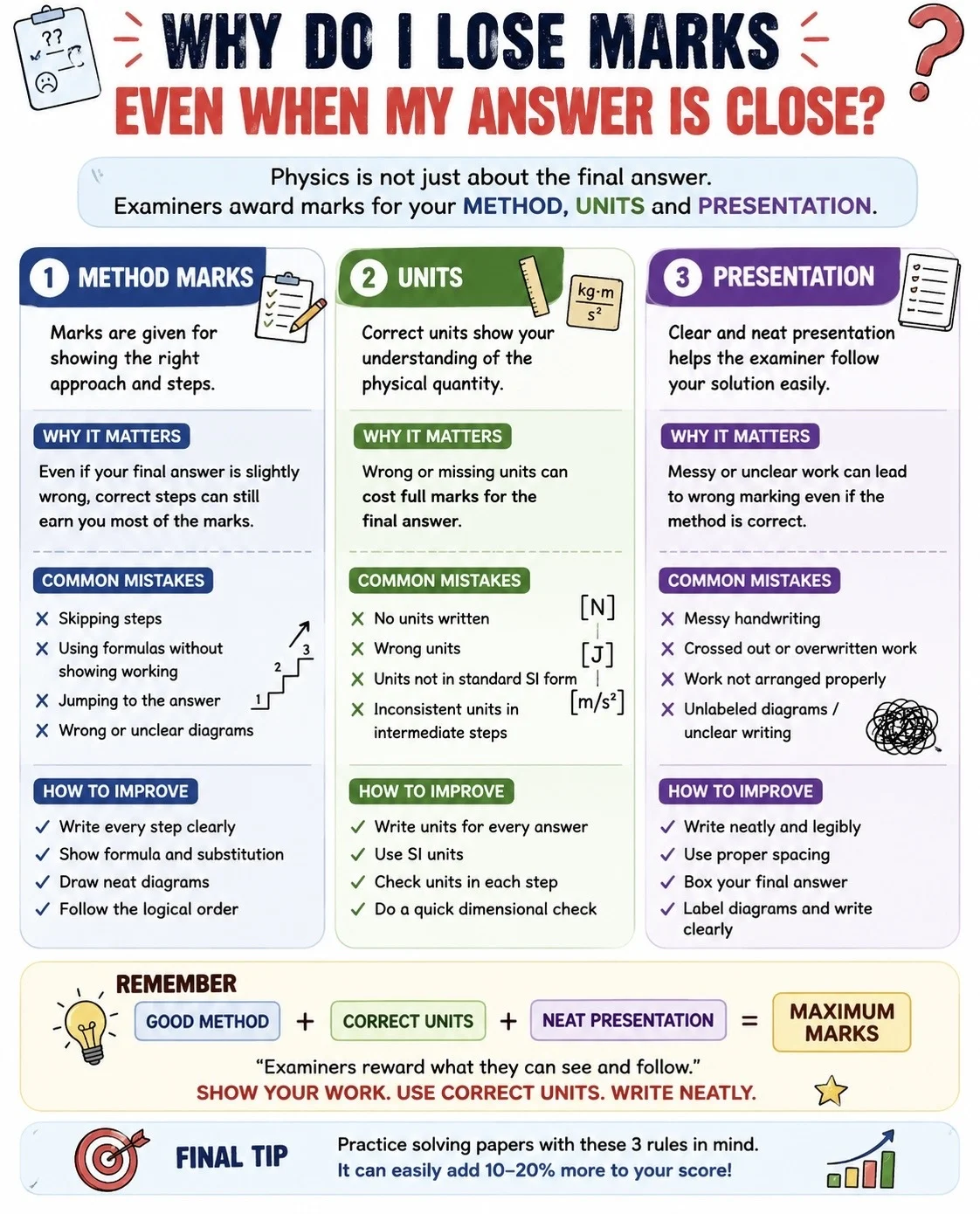
Physics marks are not only for the final answer. Examiners award marks for:
- Method
- Units
- Presentation
Worked Example (with full marking logic)
Question (typical physics problem)
A body of mass 2kg is acted upon by a force of 10N. Find acceleration.
Step 1: Write the correct formula (Method marks)
F = ma
10 = 2a
Step 2: Solve correctly
a = 10 ÷ 2
a = 5 m/s²
Step 3: Add correct units (VERY IMPORTANT)
Final answer:
a = 5 m/s²
Why students lose marks even if “close”
Method mistakes
- Skipping F = ma step
- Jumping directly to answer
- Using wrong rearrangement
Unit mistakes
- Writing just “5” instead of “5 m/s²”
- Missing SI units completely
Presentation issues
- No clear steps
- Messy working
- No formula shown
Examiner logic (defence of marking scheme)
Even if final value is correct, marks are awarded step-by-step:
- Correct formula → Method mark
- Correct substitution → Working mark
- Correct units → Accuracy mark
- Clear structure → Presentation mark
Final takeaway
Good Physics answers =
Method + Units + Clean steps = Full marks
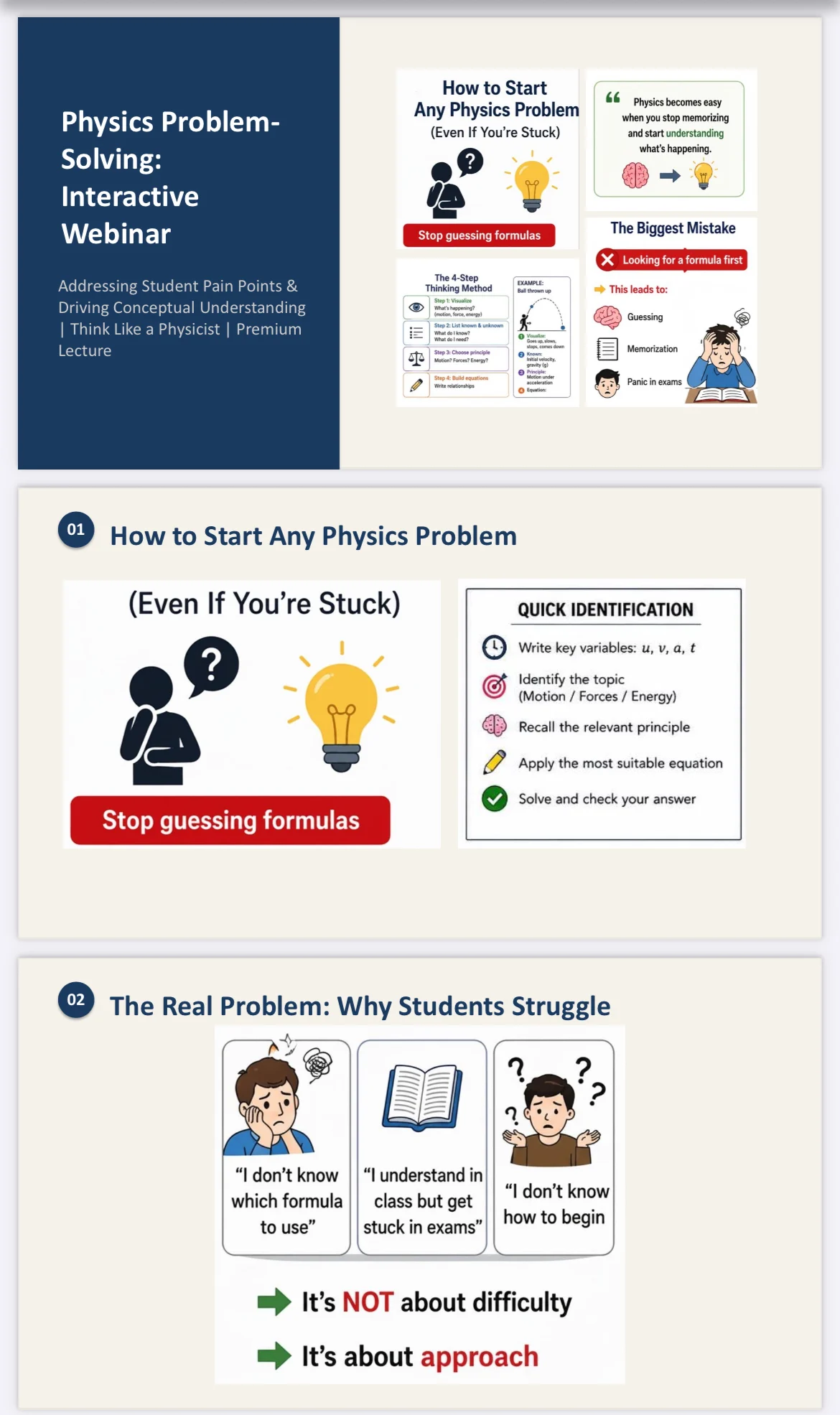
Many students say:
• “I don’t know which formula to use”
• “I understand in class but get stuck in exams”
• “I don’t know how to even begin”
Here’s the truth:
It’s NOT about difficulty.
It’s about your approach.
I’m hosting a FREE Interactive Physics Webinar where I’ll show you:
- Why students fail physics even after studying hard
- The biggest mistake: starting with formulas
- A simple 4-step method to solve ANY physics problem
- How to identify whether to use Motion, Forces, or Energy
- What to do when you get stuck in an exam
- Live guided examples (so you actually see how to think, not memorize)
This session is designed to help you:
• Stop guessing formulas
• Start thinking like a physicist
• Solve problems with clarity and confidence
When will it happen?
That depends on YOU.
Comment your preferred time and I’ll schedule the session based on the majority.
Once finalized, I’ll share the joining link here.
If you’re serious about improving your physics problem-solving skills, don’t skip this.
Type “I’M IN” + your preferred time below
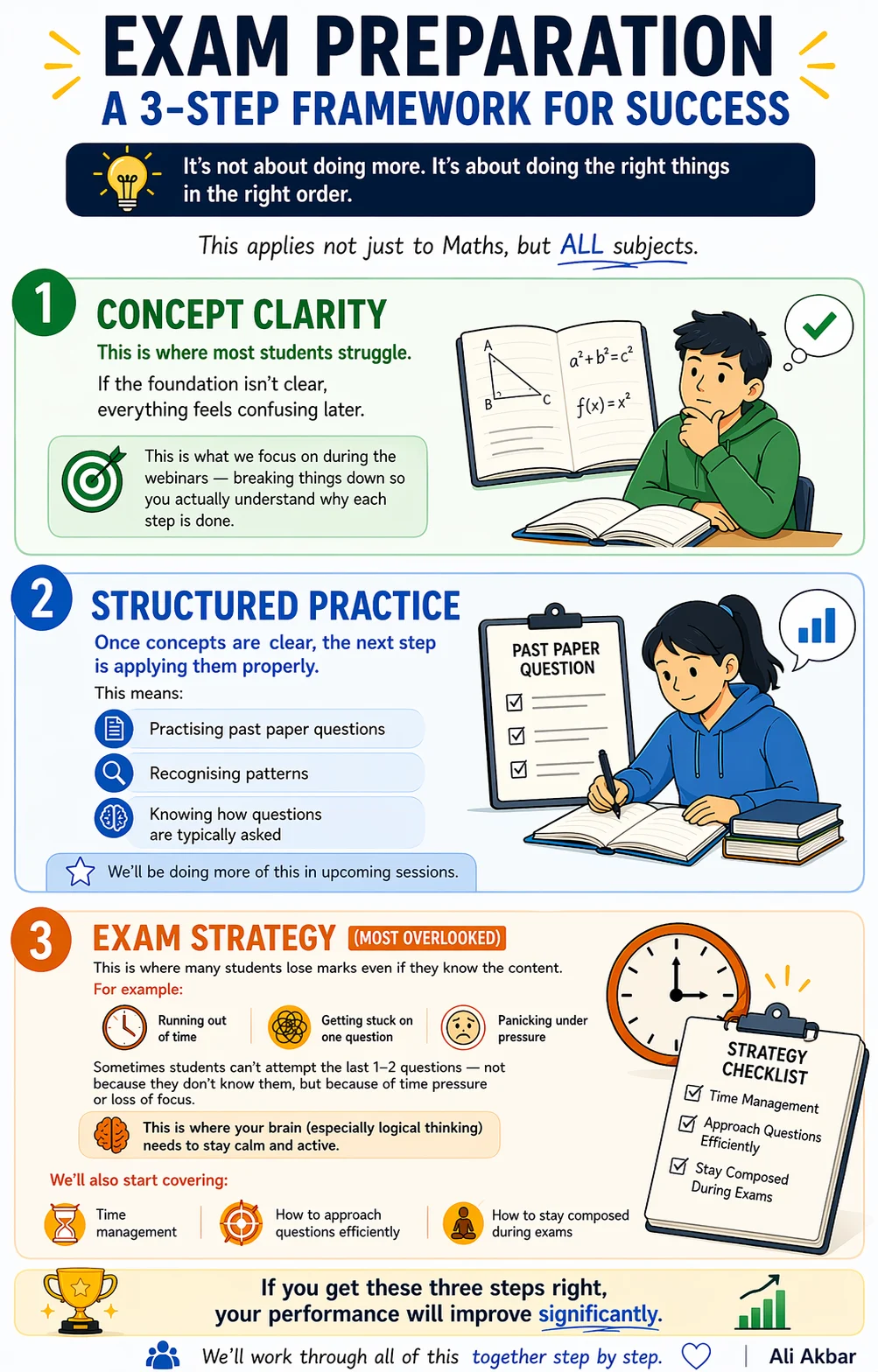
Success in exams isn’t about doing more, it’s about doing the right things in the right order.
This 3-step framework focuses on what truly drives performance:
- Building strong concept clarity as your foundation
- Reinforcing learning through structured practice
- Applying smart exam strategy under pressure
Many students know the content—but lose marks due to poor execution. The difference lies in preparation and approach.
Get these three right, and your performance won’t just improve, it will transform.
Let’s build this step by step.
I’ve seen loads of students posting on Reddit and getting:
- No replies
- Half-answers
- Overcomplicated explanations
Let’s change that here.
Drop your question below and I’ll go through it clearly, step-by-step.
Here’s one to get started:
Question:A car accelerates from rest to 20 m/s in 5 seconds.
What is its acceleration?
Formula:
acceleration = change in velocity / time
Calculation:
a = (20 − 0) / 5 = 4 m/s²
Tip: In Physics, always:
- Write the formula
- Substitute values
- Include units
If you’ve got a question you’re stuck on (mechanics, electricity, anything), post it below
We’ll also start tackling real exam questions together so you can see exactly how to approach them.
Let’s build a space where your questions actually get answered