


I talk a lot about thematic mind maps and how they can be a great way to revise, but I've never actually showed you one!
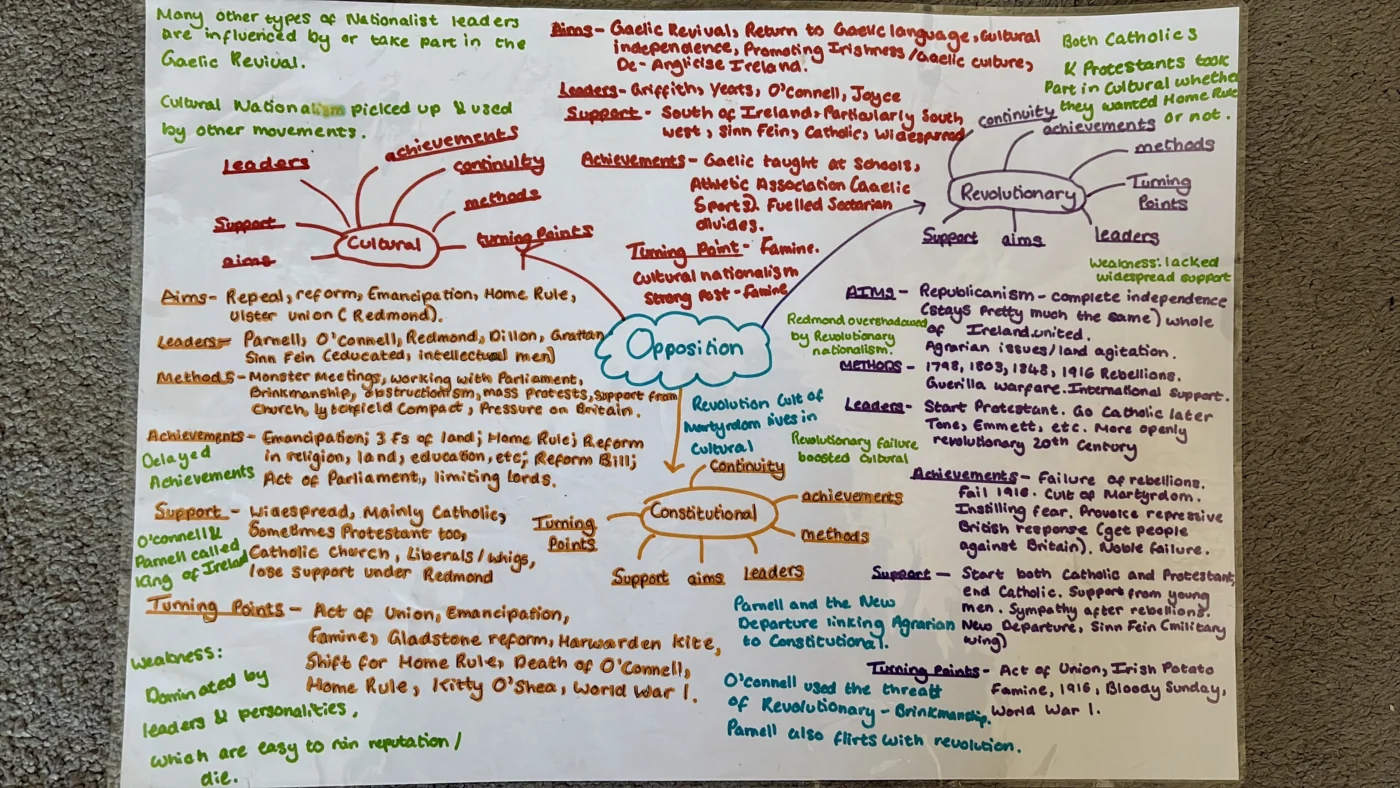
So, I managed to dig up one I did when I was doing my own A-levels three thousand years ago. It's slightly damaged with time, but it's still easy to see what I mean by colour coding and stuff like that when you look at this.
This was for my OCR unit on Britain's colonisation of Ireland between 1791 and 1921. I believe they still do a similar course today! It was one of my favourite topics to talk about because it's so relevant to us in modern society for so many different reasons. Settler colonialism and violence against an indigenous group of people are things we're grappling with around the world 100 years later.
Knowledge organisers can be really beneficial when it comes to helping you revise for your exams. However, if someone else has prepared the knowledge organiser for you, then you're only passively consuming it! Actively engaging with your revision and thinking for yourself improves the amount of information you retain by a huge amount. It's to the point where I would argue that 1 hour of using the information you got from your course is better than 4 hours of reading and looking at course materials that have already been made (either by you at an earlier point or someone else).
So, producing your own knowledge organisers like this is a powerful way to make sure you get the top grades. Plus, if you're anything like me, I love any excuse to get out all the stationery I can. I used to always try to find any excuse to get my parents to get me new pens or something, and what better reason than revision?
The mind map works like this:
The main middle bubble leads to the 'big ideas'. In this case, I split 'opposition to British colonialism' into three main areas: cultural, revolutionary (violent) and constitutional. Then, I turned each of those 'big ideas' into a mini mind map where I explored specific examples for each. So I spoke about aims, leaders, support, turning points, etc specifically.
The green peppered throughout are for me to make connections or notice interesting things that would help me to be more nuanced in my essays.
The good thing about this method is that the three 'big ideas' work as topic sentences for the main body paragraphs. The other content inside of those smaller mind maps would be the content of the paragraphs. The green helps me to make connections in the introduction and conclusion (or, at least it would if I was more systematic with how I organised this mind map. It's been over 10 years now, though, so I couldn't find any of my later examples where I'd got the system down better).
If I were to make this mind map again, I would change the colour coding. Instead of having one colour per 'big idea', I'd separate it by the type of information I'm adding to the mind map. So, the three big ideas would be one colour, then the dates would be another, then key figures would be another, etc. That way, it's visually easier to separate the different assessment objectives.
This works for English, too! The 'big ideas' would still your topic sentences for each paragraph, but they would be more interpretation-based. It would still involve categorisation, though!
Hello History students! Welcome to the Shani's Tutoring History space!
This space is dedicated to people aged 16-19 who are studying for an A-level, IB, Scottish Highers or their country's equivalent in History.
I made this space so that we can:
- Share tips and advice on getting the best grade in History.
- Have a safe space to vent to people who are in a similar boat to us.
- Share useful documents like essays and fact sheets.
The space is free to join, and I encourage any students in that age group to post any History-related topics they want. The space is not going to be particularly useful to you if I'm the only one making posts!
I check the community at least twice a day for new things students have said and subscribe to get emails about all new content. So I'll be available quite quickly to help you if you need me.
However, don't feel like you can only talk to me! One of the best ways to improve in History is by talking to other people who do the same subject as you. Collaborative and social learning improves your essay writing skills, makes revision easier and lessens the burden on you when you feel like you're on your own.
I hope this space proves useful to you! Let me know if there's anything I can do to help you!