


Hi!
This is the second statement in my series of discussions. These are aimed at helping you to hit top AO1 marks by making your essays sound more argumentative. It's excellent revision, because it forces you to think about your texts in different ways!
This week's discussion prompt is:
Literature suggests that power is maintained more by language than with physical force.
Prompts
Here are some prompts to get you started:
- Which of the texts you're studying would be interesting to talk about for this statement?
- What does it mean to 'maintain' power?
- What do we mean when we say 'language'? The words people use? The different languages they speak? Accent and dialect? etc.
- How can you maintain power with language?
- What kinds of power would you want to talk about here?
- Is it different if we're talking about different kinds of power?
- Is the answer true for all people in the text(s)? Or is it different depending on a person's identity?
- Do certain people experience more physical force while others experience more language-based things?
You might have your own questions or thoughts, so don't feel bogged down by mine. Either way, comment as many times as you like! I'll be there to watch and add input where we need it.
Hi all!
I know many of you are concerned about building AO5 for your exams! So, I've put together a curated book list of Connell Guides on my Bookshop.org affiliate shop that you can have a look at.
The Connell Guides series is absolutely excellent. They produce tiny books packed with short, two-page essays that are absolute gems for revision. They help you in so many ways:
- Of course, the main way is that using these books builds your AO5.
- It also helps you to build your AO1, if you write short summaries of your essays in your own words and explain why you either agree or disagree with the interpretations in them.
- You can build great vocabulary, which will improve your AO1 and also help you to write more effiiciently.
- It's great revision. The more essays you read, the more you'll remember and understand the texts!
- You can quote the writer directly for quoted critics AO5, but they also explore different critical theories and the works of thinkers who speak about literature and culture! So you can do multiple different kids of AO5!
So, I really recommend checking them out here!
Please note: as a Bookshop.org affiliate, I earn from qualifying purchases.
If you're not sure how to use them in your essays, check out my FREE blog post guide explaining how to do AO5 well!
Hi all!
This is the first in my series of discussions, as promised.
This week's discussion prompt is as follows:
Literature shows us that people are always performing.
I've designed this discussion series to ensure that you get great revision that doesn't feel like revision. Just comment your thoughts! The more you engage with these discussions, the better your essay writing will get!
But remember: I'm not expecting you to write an essay! Just share your thoughts!
Prompts
If you're interested in joining in, here are some things you might want to consider. They'll help you write a more A*-worthy answer:
- Which texts are you writing about?
- What does it mean to be 'performing'?
- Are there any characters in your text that are performing?
- Are there any who are not?
- What are they performing for or about?
- Do you think the statement is suggesting that all people perform or that there's something wrong or inhuman about people who don't perform?
You might have your own questions, so don't feel bogged down by mine. Either way, comment as many times as you like! I'll be there to watch and add input where we need it.
Hi all!
Weekend! Woo! I hope you're all going to enjoy it!
In order to make Shani's Tutoring more useful to you (and also to get conversation going more), I thought I would start creating some AO1 discussion statements!
This is based on my paid course over on the Learning Hub, where I set students weekly essay prompts that they write a response to. I then mark those essays, give you a grade and give detailed feedback on how to get closer to the A*.
But I thought I would give you a flavour of that course here!
How it works
Each week, I'll post a statement that relates to most A-level texts in some way. It will usually be something that people disagree on the answer to, so that you can start thinking!
Then, you can comment with your own thoughts on whether or not you think the answer is true of the texts you study and why.
You can either do a single text or a comparison text.
It would be great if you can give some examples, too! Paraphrase the text, if you have to! That will be excellent revision for you all!
I recommend you look at other people's comments, too. Reply to them if you disagree (but do so respectfully) so that we can make this as discussion-based as possible! It will help your essays massively.
If you're joining in, please make sure you let us know what texts you're talking about, and maybe also what exam board!
I'll post an example on this week's one, but I hope you'll join in with your own!
Why this is helpful
The more you engage with statements like this, the more your AO1 will improve. That's because:
- The statements are good examples of AO1, so your answers will create A* topic sentences for essays if you do them well!
- You'll have clearer, more niche interpretations of the text.
- You'll be forced to think about your texts in different ways.
- You're revising without even realising. The more you engage with your texts and think about examples from them, the easier it will be for you to remember important quotes and events in the exam.
- It's a safe space for you to make mistakes, agree or disagree, or even try to defend an argument that you don't usually agree with! I love it when students try their own thing, so you don't have to have a perfect argument!
- Since I'm not expecting essays here, so you can work through your ideas in your own words before you try to 'translate' them into academic English.
- You'll have access to me (a teacher) who will be there at every step of the way to help you. I'll provide useful vocab if it comes up to add to your repertoire.
- I'm trying to make these statements based on questions that could actually come up in your exams. So it should provide you with great preparation.
What I'll do
I'll be around, looking at people's responses and asking questions to get them thinking more deeply about the texts they study. I might not reply to every one, but I will try my best!
Since this is supposed to be more of a discussion community, I won't mark your essays (you'll still need to join the subscription for that), but I will be able to give you tips on what you could do if you turned it into an essay.
If this sounds good to you, please do give this post a like! I'll be posting the first one today. I'll provide my own example of this today and we can see how it goes from there.
(P.s. still working on the essay resources! They're just getting more and more in depth, so they're taking longer. I'll post updates if you're interested)!
In my effort to try to become a trusted online source of information about the A-level English exams, I've set up notifications for the A-level English literature subreddit so that I get pinged every time someone posts. Hopefully we'll eventually be able to grow our community with people who trust me and I can make this place more active (the best outcome would be that people would make their own posts and invite their friends)!
This week, there have been a few different posts about AO5, and I've noticed that there are some misconceptions about it! So, I thought it would be useful and interesting for me to list them for you! If this is useful and liked by the community, maybe I'll make a blog post where I explain why they're misconceptions and what the actual truth is!
So here are the big ones I've noticed from students:
- Doing AO5 well in the exams is just about making sure you know lots of quotes from lots of critics. ❌
- Naming critics is the highest form of AO5 – better than being able to talk about adaptations or critical theory. ❌
- You're only allowed to use famous critics or people who published for very prestigious universities. ❌
- You should learn 2-4 critical interpretations per text. ❌
- Your AO5 needs to be unique for each text you study. AO5 can't be shared across texts. ❌
- You always need to agree with the critics. ❌
- It's enough to add what the critic said and then move on. ❌
- You have to know the name of the critic for it to be proper AO5. ❌
- The examiner is going to check to make sure that the critics you use have been peer reviewed and are on JSTOR. ❌
- You need to find AO5 that agrees with your perspective. ❌
I think my blog post on AO5 clears up a lot of these misconceptions, but it might be useful to make a specific post about it that addresses the problems properly!
What do you think? Do you think I should make a blog post where I explain why these misconceptions are wrong and what the truth is? Let me know what your thoughts are by commenting, and feel free to post any other blog post suggestions for me!
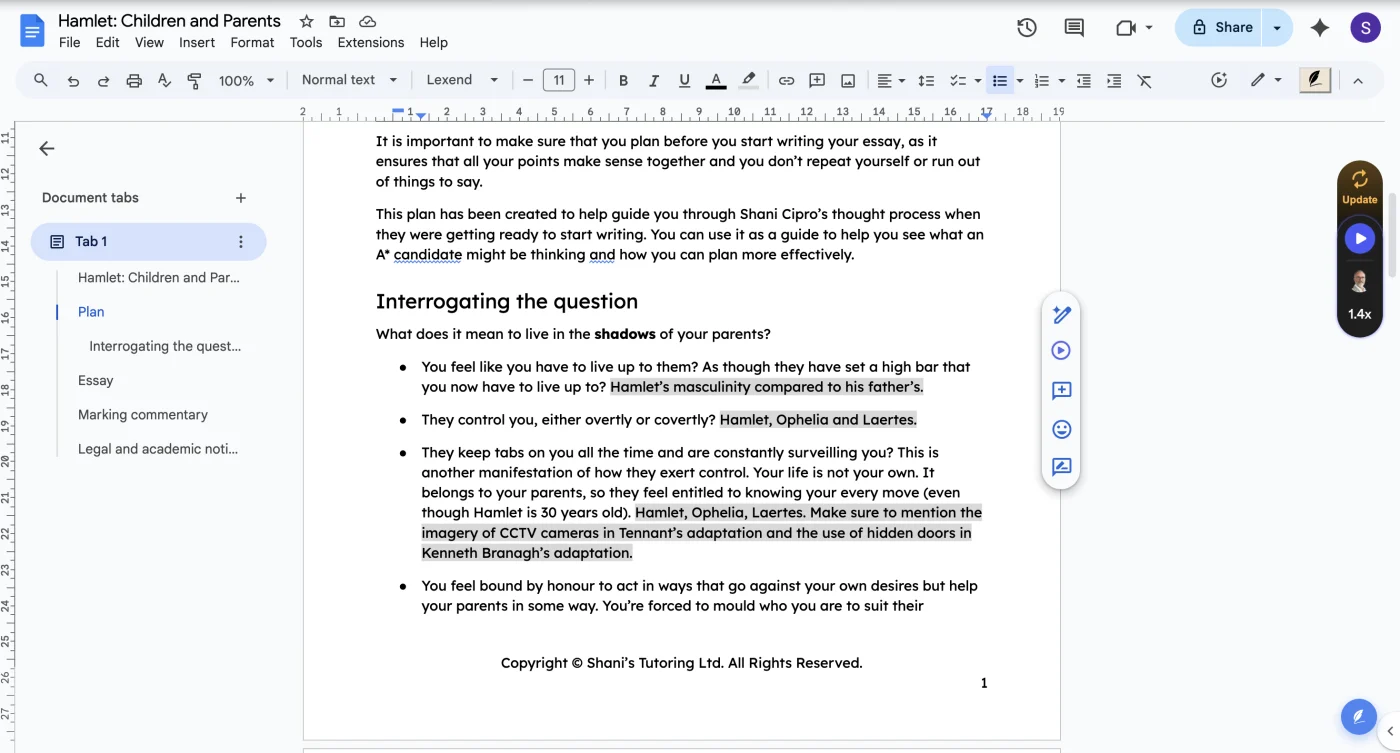
I'm currently working on the essay requested by Khadija S.! We're going to be looking at Hamlet question b of the OCR paper first, because I just marked a stack from my students at school and have some notes.
I thought I'd give you a sneak peek into how things are going there. As well as giving you some essay models, you'll also get to see my plan!
I might not end up completing absolutely everything that I wrote in the plan, but I thought it would be a really nice way for you to be able to understand how I wrote this A* essay and what my thought process was before I started. It could even mean that you can continue the essay or write something for the same essay question, if you choose to!
I just want to remind you that I am currently doing an MA in English. That means that anything I write in these essays does count as AO5 alternate interpretations, and you are welcome to reference me for essays! You just have to refer to me by name! That would be 'Shani Cipro' if you're talking about me in the body of the essay. Or, if you're putting me in a footnote or bibliography, it would be 'S. Cipro'. I'm going to be putting the important citation notes on each document, too.
Hi all!
I'm in an essay-writing mood. So, I'm going to take the next couple of weeks to make some essay samples for our community!
These new essays will be located in the 'documents' section of this space! If you can't see the documents, make sure that you've joined the space (it should prompt you to join at the top of this post). Bear in mind, they might just be sections of essays rather than the full thing.
This is going to be a FREE perk of being part of the space. The only thing I ask for in return is that you promote this community, please! I really want it to become an amazing space for students, and I need your help to do that!
I'd love some recommendations of texts you would like me to cover! Make sure you let me know what text(s) and which exam board you're doing by commenting below!

Hi all! Another great question asked by Noor R. : how do you structure an A-star level answer for Othello in Edexcel's Paper 1 exam?
I'll try my best to give you a mini guide here, but remember that I am going to be creating a course on writing good essays in the future! So, please be on the lookout for that!
In my experience, Edexcel is the most nitpicky of the exam boards. They tend to shock the teachers the most on results day, because they can be quite harsh in places. They're not supposed to mark down, but it can feel like it! I guess that's the way they keep things fair, since they have open book exams. So, it's important that you know exactly how to give them what they want to avoid any disappointment.
What are you being assessed on?
One of the most important things to establish when you're figuring out how to write an A* essay is which assessment objectives the question is asking you to cover. For this one, you're doing pretty much all of the AOs, except one:
- AO1: Having a strong, nuanced argument and presenting it in a strong and convincing way (e.g. good structure, using the right subject-specific vocabulary, academic register, not contradicting yourself)
- AO2: Analysis of language, structure and form. Explaining how the way the text was written helped you to come to your interpretation. Try to vary this as much as possible. We're moving away from just zooming in on specific words at A-level. Really focus on structure and form, as well.
- AO3: Incorporating context of both when the text was written and when it was read/seen. That's one of the big differences between GCSE and A-level, really. At this point, you need to be able to understand that different types of readers react to the same text in different ways. For example, a black man living in London in the 21st Century isn't going to react the same way to Othello as someone kicking around in Shakespeare's time. So don't just go with boring points about how 'In Shakespeare's time, women were treated as second-class citizens/property...'. So think about what's going on around different kinds of readers that make them react in the way they do.
- AO5: Thinking about different interpretations that aren't just your own. You can use these to back up what you've said, or you can refute them. Either way, they show that you're really smart because you're avoiding acting like every interesting point about Othello popped out of your head spontaneously. You're showing that you know centuries of people have spoken about the text, and that they have interesting things to say. Then, you can tie it beautifully with AO3 (but we'll get onto that).
Introductions
In your introduction, you should not be speaking about specific quotes or moments in the text. That's not the point of your intro! The point is for you to interrogate the question and come up with a big idea that's going to underpin all of the other ideas you make in your essay.
My favourite teacher-colleague at work calls that big idea a 'macro-point'. I really like that! But what does it mean? Well, it's about being able to combine the smaller, micro-points that you make in each paragraph (your topic sentences) into one or two sentences that brings them all together and sums them up.
For example, let's say that you get an essay question on the theme of jealousy in Othello (like in June 2022).
A good student might have paragraphs that talk about things like this:
- Micro-point 1: Jealousy comes from feelings of powerlessness and inadequacy. (Othello feels inadequate because of his race, Iago because of his low social status and lack of wealth, and Roderigo because of his romantic failures). All of these characters are feeling inadequate about something and it manifests in fits of jealousy.
- Micro-point 2: Jealousy is intrinsically linked to manipulation. Not only is Othello manipulated to become more jealous in the first place, but then Iago uses that jealousy to manipulate him further. Roderigo is also manipulated by Iago because of his jealousy. The same with Bianca. Although interestingly, Othello isn't using Bianca's jealousy to manipulate her. He uses it to manipulate Othello! It's interesting that women are tools rather than the focus of manipulation.
- Micro-point 3: Jealousy leads to sinful, immoral actions, including retribution. We're not just talking about the bloody, violent end here, but also the actions of Roderigo and Othello striking Desdemona.
Now we've got to find a way to bring all the points together in the introduction to make a bigger point! For me, this macro-point would probably be something along the lines of jealousy being a social disease that stems from existing inequalities within society and disrupts the body politic. Then I could explain it a little more in my intro by briefly mentioning my micro-points.
I'd end the introduction with some information about why I think Shakespeare has presented jealousy in this way based on the context of his time.
Main body paragraphs
In the main body of your essay, an A* student shouldn't begin a new section by talking about a specific character or moment from the text. Why? Well, a single character or scene in the play can embody so many different themes, ideas and messages. So things can get very messy very quickly and you'll end up repeating yourself way too much. That's not the sign of a high-level essay.
On top of that, AO1 should underpin every single part of your essay. It's the most important assessment objective! So, the best way to prove to the examiner that you're doing enough of it is to start every part of your essay with it!. Doing that allows you to make comparisons between characters and scenes that you can't make very efficiently or effectively if you try to go one character at a time.
Instead, you should start with a micro-point, like the one I showed you above. That allows you to pull evidence from lots of different characters and parts of the text and show similarities between them. You can cluster quotes very well and show that different characters and scenes use similar language, structure and form to convey the same message. It's a sign of an A* student to be able to range across the text rather than going chronologically.
So, your first sentence of a main-body section might look something like this:
Shakespeare presents jealousy as stemming from feelings of powerlessness and inadequacy.
That then allows you to talk about lots of different characters and beef up your paragraphs with lots of quotes. After all, a good A-level paragraph should have at least 5 short quotes in it, in my opinion.
Then you can move onto noticing similarities between characters: Othello, Roderigo and Iago all experience the feeling of not living up to society's hegemonic expectations of masculinity, for example. This then manifests in jealousy.
Once you've found these similarities between different characters and moments, the next step is to prove that! How do you know they feel inadequate or powerless? How do you know that this leads to their jealousy? Give me lots of quotes and point out of the language, structure and form of your examples makes us think that.
Tying AO3 and AO5 into your main body paragraphs
Make sure you are always talking about AO3 and AO5. The nice thing is that, as I mentioned, they can often go hand-in-hand.
Of course, you can and should be thinking about the social, economic, historical, linguistic, literary and biographical context going on around Shakespeare. The othering of people of colour at that time, for example. This will help you to think about why Shakespeare has made the text the way he has.
But also, it's important to think about your own context and the context of other people reading the text. A good way to do that is to tie things back to AO5. For example, a Postcolonial scholar reading Othello might draw attention to the othering of Othello as a character and how Roderigo's feelings of entitlement towards Desdemona in part stem from the fact that because Othello is a foreigner, he perceives him as less worthy of Desdemona's love. He acts more violently towards Cassio because he actually sees him as a threat in a way that he doesn't with Othello.
A more intersectional critic might build on that and comment on how there are interesting similarities between race , gender and lack of social status in terms of how they can prevent you from accessing the true benefits of a white, patriarchal society. A Marxist critic might agree with that, but also point out the fact that the one person who is presented as a villain is the one of a lower class (Iago), which suggests that working-class people are viewed with more scorn.
Think about how a black person reading in the 21st century would perceive Othello's jealousy when reading the text. What's going on in the world around them that would make them read the text in that way? And how would that be different from Shakespeare's contemporary readers?
Of course, you should also be adding in information from the tragedy anthology that Edexcel gives you.
Conclusion
Your conclusion should be about explaining how you used your micro-points to come to your macro-point. How did the micro-points make you come to the conclusion that jealousy is a social disease?
Tips
Some extra tips for you:
- Check out my AO5 post so you know the different ways to do AO5.
- Avoid feeling like you have to structure your essay in PEEL or PEA or PETAL or something. Just start with a good AO1 point at the beginning of each section and then talk me though your thought process of how you got there. It's about making sure you include analysis, context and alternate interpretations, not about forcing you to follow a rigid order!
- You don't have to do everything in one paragraph! If the paragraph gets too long, switch to another paragraph to continue your argument. It's the section of your essay that needs to start with a good topic sentence, not each and every paragraph! Sometimes, one section is longer than a paragraph. In that case, you might want to start it with an AO5 alternative interpretation from a critic instead, as long as you can tie it back to your topic sentence.
- Interrogate the question. Before you start, ask yourself, 'What am I even being asked here?' and that will help you to structure a good A* essay.
- Always put your interpretation over the characters. The characters aren't real people! They're tools, just like similes and metaphors are.
- Try to learn some good, high-level language like 'hegemony', 'body politic' and 'microcosm' so that you can sound more sophisticated and speed up your writing.
If you are studying The Handmaid's Tale for your A-levels, I think there are some really interesting AO5 points to make about the TV series. So, I thought I'd make an AO5 discussion thread for us to talk about it!
Personally, I loved the TV series, and I highly recommend watching the whole thing! However, if you're using it for AO5, most of the important stuff happens in the first season. You don't have to watch the whole thing because the rest of it goes beyond the novel, so there's not much to compare to the original text.
As always, I'm going to comment my thoughts below about what I noticed about the text! However, I highly recommend you add your own thoughts or something you discussed at school, too! This community can be a great way to organise your revision – if you use the bookmark feature well.
If you need to brush up on what AO5 is and how to talk about it, I recommend checking out my blog post about AO5! It's full of useful information on how to do it well. This version of AO5 would fall under the umbrella of 'Adaptations'.
Essay feedback is one of the best ways to improve your English grades. Here are some of the ways that it helps you to boost your grades.