
In one of my recent blog posts, I revealed that I’m going back to uni. It was a surprise to no one, really! Everyone knows how much I love studying. But I made loads of mistakes the first time I went, and I’d rather not repeat them.
One of the most important skills for success is being able to reflect on your past mistakes and improve. As hard as it can be to admit you’re wrong (trust me – I struggle with that), it’s the best way to help you become the best version of yourself. So, that’s what I want to do: make the most out of uni this time around.
This is especially important because I’m not quitting my job. I’ll be working full-time and studying part-time. It’s going to take a lot of self-reflection and organisation to make sure I don’t fall into old patterns.
Plus, I’m hoping to get a distinction! It’s not impossible, but I’ll need to change some of my study habits to get there. That means I’ve got to reflect on my past mistakes. I’m not wallowing in self-pity – I just want to start off on the right foot.
And I know for a fact that I’m not the only one who makes these mistakes. Most of them are quite common! You might pick up a thing or two that you can avoid in your own uni journey.
So, let me introduce you to the 12 mistakes I made the first time I went to uni. I’ll lay out what went wrong how I can improve. Hopefully, you’ll find this useful for you, too!
Mistake 1: Not choosing the course I was passionate about
In my first year of uni, I was convinced that I wanted to do history. The open day lecture about medieval Scotland had won me over. Plus, I had an amazing history tutor who made me adore the subject – shout out to Mr Moore!
However, I quickly discovered I loved English even more than history. Every lecture energised me, and I spent my free time reading everything on the reading list. It got to the point where I finished my first English Language exam with over 30 minutes to spare! If that isn’t love, I don’t know what is.
By the end of year one, I was sure that I wanted to do English. In fact, it was obvious: the one history essay where I got over 95% was about the role of literature in liberation movements. I mean, come on!
But despite knowing what I wanted, I settled for history.
Why? Well, people were already worried that I wouldn’t get a good job if I didn’t do a STEM degree. If it were up to them, I’d be a therapist or something. I’d be good at it, and the money’s great! To them, history wasn’t ideal, but it could lead to a job in an office doing HR or something. English would stress them out even more.
But eventually, I lost steam. I wasn’t doing what I truly loved, so my heart wasn’t in it. That made it hard to stay motivated in harder times. Then, I ended up becoming an English teacher, anyway! It’s better to be excellent at what you love than to be average at what you’re expected to do.
So, this time, I’ll follow my passions. If I change my mind about Literary Linguistics, I’ll switch to another specialism. I’ll listen to my heart.
Mistake 2: Not reaching out when I was struggling with my mental health
At some point later in my time at uni, I had a mental health crisis.
I struggled to leave the flat, stopped eating well and working out, and lost contact with my friends. The crisis made it really hard to focus on my work – or even to get out of bed in the morning. It was hell. But I didn’t seek help.
Why? Well, because for the longest time, I thought I was lazy. In my head, I didn’t do homework at school because I just couldn’t be asked – even though I was obsessed with learning and improving my grades. I thought that was why it took so much mental effort to do simple tasks like cleaning my room. So when my mental health went down the toilet, I thought it was an extension of that. I thought I was getting lazier.
I was so wrong. Firstly, I wasn’t lazy. I was neurodivergent. Simple tasks overwhelmed me because my brain works differently. And because I didn’t know about my needs, I couldn’t spot when my mental health was bad. I mean, I didn’t want to feel too stressed to leave the flat. But also I didn’t want to be too ‘lazy’ to do homework at school. Those two things didn’t seem different to me.
So, I didn’t get help until I came back to live in London.
That was one of the biggest reasons why my grades weren’t as good as I’d have liked. It also affected my physical health. In fact, I’m still trying to recover physically from what I put my body through.
If I had taken the time to reach out for help, I would have found out I was neurodivergent. That would have made it easier to spot the depression and seek help.
Mistake 3: Missing too much uni
Then there were the days when I just couldn’t be asked to go to uni.
It wasn’t just because I’m neurodivergent. Sometimes, I missed the shuttlebus to uni, and promptly got back into bed.
In my previous post, I said that the big reason for this was because I didn’t see the value of uni. I saw it as one more thing to check off my ‘things everyone does’ checklist. So, I didn’t really have the fire in my belly to show up every day.
They didn’t take attendance for lectures, only seminars. So, in my head, I could miss the lectures, as long as I did the reading and showed up for discussions, right? I remember one time when there was a lecture on Robert the Bruce. I’d already read about him in the textbook, so I thought I could skip that one.
The problem is that uni (and even A-level, really) isn’t just about knowing facts. It’s about constructing arguments and evaluating how much you agree with different perspectives. You kinda need to listen to more than the textbook to do that. Plus, if the professors didn’t think they were adding something to the reading, they’d just send you away with the book.
Uni isn’t like school. Here, you’re paying for your education. You’ll be in the same amount of debt no matter your grade. So, you might as well make sure you’re getting value for your money.
This time around, things are a little different. All of my courses are online, and there are no live lectures. So, I don’t need to worry about missing anything. However, I’m still going to make sure that I take full advantage of every resource I get – all the optional things, too.
Mistake 4: Not making the most out of the library
If you’ve never been to a university library, you should check out a tour on YouTube. Here’s one for Glasgow, my old uni – and Nottingham, where I’m about to study.
Uni libraries are safehavens for students. They’re packed with everything you could need for your uni course. That’s the reason why I consider libraries to be the heart of universities. You’ve got all the books you could need, wifi, printers, study spaces and much more!
There’s only one place I’ve been to which is better for studying: the British Library.
I’ll be honest, though: when I was at uni, I didn’t make the most of the library.
Don’t get me wrong! I started out strong the first time! I went every day until November. But Scotland is super cold in the winter. So by November, I just wanted to go home and snuggle up with some hot chocolate after a lecture.
When I went to uni the second time to do my PGCE, I didn’t even pick up my student ID card! Shameful, I know. I didn’t plan on taking the 1-hour bus trip every time I wanted a book, but I still could have kept it as a souvenir.
In the past, when I needed a book for an essay, I’d check if there was an online copy. Usually, there was. On the rare occasions when there wasn’t, I’d just look for a different book.
But the thing is, physical books can be better for studying than ebooks. People remember more when they can physically turn pages. Plus, post-it tabs help me to keep track of the references I want to use.
So, this time around, I’ll use the library more. Nottingham delivers books to distance learning students, so I’ll order them whenever I need them.
Mistake 5: Not being social enough
The first time I went to uni, I didn’t really stick to any clubs or societies. I tried the Japanese and musical theatre society, but I didn’t really click with anyone. So, I just dropped them. I also had some lovely acquaintances in my seminars, but I didn’t take the time to actually keep up with them and turn them into friends.
I’m also notoriously bad at maintaining the friendships I have. I lost contact with my best friend from uni because of that! I suck at small talk, so I don’t check in with people as much as I should. My notifications pile up and I forget to reply to them. Then, it looks like I’m ghosting them! Then I get anxious about replying to them too late, because I worry that they’ll hate me for not replying for ages. So, I drop it.
It’s never intentional, but it’s a serious character flaw.
When you’re an adult with a job, it’s much harder to make friends. You’re not surrounded with people with similar life experiences and hobbies like you are when you’re at school or uni, so it’s harder to relate to the other adults in your life. There are people that I enjoy talking to at work, but we don’t have that much in common. I don’t think we’d be able to hold a conversation outside of a school setting.
So, this time around, I want to get involved with some more social sections of the course. I’ll make an effort to check in with people, and turn replying into a habit. Uni is such a good time to make friends and expand your network. I’m not going to miss that opportunity again.
Mistake 6: Feeling too shy to talk to my professors and ask questions
The first time I went to uni, I’d never speak to my professors outside of seminar time. I wouldn’t email them with questions or turn up to their office hours. I was convinced that I was wasting their time – even when they explicitly set aside time to speak to students.
So, I had a lot of questions about my course material that went unanswered. Looking back at them, most of them were good! They could have been useful for other students, too! But I was too shy to ask.
That was even true of my dissertation supervisor! I didn’t speak to him once because I didn’t want to be a bother until I felt more confident about my work. That time never came, and I submitted a dissertation that was definitely not my best work. Ridiculous.
But remember: you’re paying to study. So, get your money’s worth!
It’s part (but not all) of your professor’s job to help you understand the course. But it’s not their job to chase you or check you’ve understood. Could you imagine if they had to check on all 400 of their students? It would be a nightmare!
Professors are a living resource that you can tap into as and when you need. Most of them love hearing from you – especially if you’ve read their academic literature and have questions about it. You just need to make sure that you self-reflect on what you need more help with. No one can do that for you anymore.
Other students might make fun of you or say you ask too many questions. I know someone did when I was doing my PGCE. But she wasn’t paying my tuition fee, so she can do one. No one liked her, anyway.
Mistake 7: Procrastinating on deadlines
I am a master procrastinator.
I don’t know if it’s the ADHD or just my personality, but I used to leave most of my tasks to the last minute. It’s silly: you find out the assignment questions as soon as you join a module. So, I could have chunked my tasks and worked little and often. I never had to stress.
Did I do that, though? Of course not! Daniel Thrasher’s video, Every Gifted Kid Goes Through THIS, sums up my attitude to about 80% of my essays:
I used to think it was pretty cool that I could just lock in like that. It can be a useful skill at times! Once adrenaline kicks in, my brain can stick to the task like a horse with blinders on for hours at a time. I don’t realise if I’m hungry or thirsty. I just work until 5 minues before the deadline so I can submit before midnight. Then, I inhale a late dinner and pass out, still stressing.
But the thing is, I don’t produce my best work like that. For 20% of my essays, I’d plan them out as early as possible and write 200 words a day. They were my best work!
It’s also not sustainable to keep waiting for my adrenaline rush. Every time I met the deadline before midnight, I’d get a little more complacent. So, the next time, I’d wait even longer on deadline day to start writing. My work quality just got lower and lower.
So this time, I’m going to take the same approach I did for the 20% of essays that I’m proud of. I can’t get away with procrastination this time, anyway. I have a full-time job to do.
Mistake 8: Not learning some useful study strategies
When you’re at school, teachers often tell you what to take notes on. You don’t have to use your initiative. They do the thinking for you.
I see it with my students. If I give them a definition of a useful term, they’ll just state at the screen like the information will jump into their heads. It’s not until I say, ‘write this down’ that they actually take notes.
The same is true for revision – especially at GCSE level! The teachers will run revision sessions, give you study resources and even tell you what you need to focus on. Never once do you need to think for yourself about what information is worth committing to memory.
But uni isn’t like that. No one is going to tell you what information is useful or what might come up in the test. So, you need to be evaluating all of your learning resources for yourself and working out what study methods will work best for the material you need to revise.
So many stuents haven’t developed the independence to study on their own. They don’t know why they’re taking notes, so they fall into some bad habits:
- They write up notes on everything they read in a book or hear in a lecture. Their notes basically become a long list of facts that they heard throughout their course, and it isn’t really tied to what they’re expected to do.
- Their notes are too basic. They only write down the bare minimum in lectures, thinking they’ll be able to remember everything they need.
I was definitely number 1. But it’s not sustainable! You can’t just recreate resource after resource in your notes and expect to actually use them. So, I have to employ some better study habits for next time.
Mistake 9: Not going over my notes after lectures
At uni, I eventually figured out how to take effective notes – although it took me longer than it should have. They were beautiful: colour coded with consistent definitions and subheadings. However, I still didn’t use them in very useful ways!
Once I wrote them, I kinda just left them on OneNote to gather dust.
If you’ve read my post on why you can’t remember your revision, you’ll know why this is a bad idea.
You see, a psychologist called Ebbinghaus carried out research that showed that we forget most information we learn within 24 houts. If we don’t want to forget it, we have to keep reminding ourselves of it over and over again. With each reminder, we forget less.
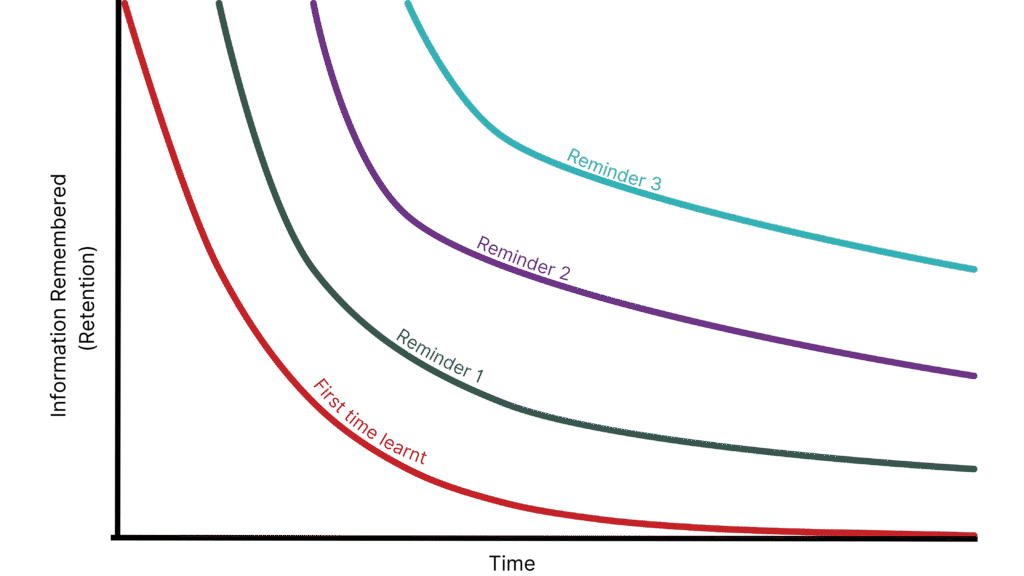
If I want to be effective at uni, I need to take this to heart. I need to go over my notes on the days and weeks after I’ve written them so that I can recall the info! It will help to cut down the amount of revision I need to do before an exam. I won’t have to cram as much!
It will make essay writing more efficient, too. The last time I was at uni, I kept having this annoying experience of remembering that there was a useful piece of information somewhere buried in my notes, but not remembering what it was or where to find it. The more I revise throughout the year, the more I can avoid this. That will cut down so much time in the long run, and make me better at my subject in general.
So, I’m going to look over my notes regularly and do something useful with them. I could turn them into flashcards or a blog post. That way, they’ll stay fresh in my head.
Mistake 10: Only reading the required texts on the reading lists
I got really into my English courses in my first and second year of uni. So, I dedicated lots of energy to reading as many texts from the reading list as I could. That’s probably why I did so well in my English exams and essays!
I can’t say I did the same for history.
You see, with arts and humanities subjects at uni, you’re not just there to learn a set of facts. You have to interpret the info in front of you. Come up with your own critical arguments based on the evidence. Consider the perspecitves of academics. Then, evaluate how far you agree or disagree with them.
Once you’ve done that, you should use the information to craft an argument that answers your essay question in a creative and personalised way. That will get you top marks.
That’s why it’s so important to expand your horizons and read more than just the compulsory perspectives that the rest of your class will be reading. If you all read the same books, you’re all going to have the same, bog-standard interpretations of the text or historical event. That’s not exactly a ‘creative’ or ‘personalised’ response to the question, is it?
So, this time around, I am going to read as much of the reading list as I can. I’ll scour the lists for the perspectives that give me the biggest reactions. That means those that speak to me the most, and those that I violently disagree with. If I find a perspective interesting, I’ll check its bibliography to see if there’s anything new or interesting there.
Academics read as much about their subject as they can. If I want to do a PhD, I should get into that mindset ASAP.
Mistake 11: Ignoring my fitness
When I had my mental health crisis, my fitness fell through the cracks. That’s a big uni mistake that I regret.
Keeping fit is such an important part of being successful at uni. When you exercise regularly, it makes you a better student. It helps to regulate your sleep, improve mental health and increase dopamine in your brain. It’s even been linked to memory and thinking skills!
Now, this isn’t about fat shaming or anything like that. Anyone in any kind of body can exercise. It will just look different for us depending on our comfort, preferences and fitness levels. You can’t see fitness on someone’s body with the naked eye. That’s not how it works. Being slim doesn’t make you fit.
This is about making sure that we all keep active and do exercises that fit our lifestyle and ability level.
The thing about uni is that the gym memberships are so cheap. It’s a great opprtunity to reap the benefits of getting active, and improve your grades while you’re at it.
But if you’re not a gym person, no worries! There are plenty of other ways to stay active. I used to just walk around Glasgow’s West End in my first year of uni. It cleared my mind so much. If you have a dog, going out for some extra walks will make the two of you happier. Or maybe you prefer swimming? Maybe dance?
With my upcoming uni experience, I’m going to make sure I don’t neglect fitness. I’ll challenge myself to do something active at least 3 times a week. I can go on a long walk with a uni-related podcast on, for example. I want to take care of myself both mentally and physically.
Mistake 12: Not thinking about how my degree fits into my future plans
I remember sitting in a seminar room for my course on King James VI. My professor, Steven Reid, asked all of us what we wanted to do with our degree once we’d finished. I hadn’t really thought about it before, so I panicked. I had been interested in becoming a Blue Badge Tour Guide in London, so I blurted that out.
The problem was, I hadn’t really thought about what I wanted to do with my degree after I finished. I thought about what I wanted outside of my degree: get married, own a house, learn a language. However, I hadn’t really thought about how I wanted to use my degree.
Now, I don’t want to stress you out. There’s nothing wrong with not knowing what you want to do with your life. I mean, I suffered through a year in admin and HR before I decided I wanted to be a teacher. Now, I want to go back to uni so I can become a uni professor! It’s never too late to try something new.
But I wasn’t even thinking about life after uni. I hadn’t thought about what jobs my degree would be useful for. That’s fine when you’re in secondary school. Not so much when you’re in the 4th year of your course, and your parents expect you to be working a couple months after returning.
Since I hadn’t thought about the future, I wasn’t focused. My courses were random and unrelated. I didn’t even think about trying new things, or recognise that I wasn’t sure yet.
This time, it’s different. I have an idea of what I want to do, but I’m flexible enough to be ok if the plans change. That’s how I’m going to be succesful at uni.
Wish me luck!


Community Discussion
or explore Future Steps