The Harkness method is about creating collaborative and student-led discussions in the classroom.
The teacher provides a text and introduces a key topic or theme for discussion. Then, they take a step back. They can either join in on the discussion as an equal, or they can focus on taking notes and recording the types of contributions each student makes.
Of course, they can step in if they feel it necessary! Usually, this happens when students are stuck on a point, need clarification on a piece of knowledge, or need the rules to be reinforced. Otherwise, teachers try their best to keep their contributions to a minimum and leave feedback for the end.
During a Harkness discussion, we encourage our students to talk to one another rather than to the teacher. We reward them for showing their collaborative skills by doing things such as:
- Addressing one another by name.
- Demonstrating they have listened to other people’s contributions by following up on what someone has just said.
- Using language that shows they are building on the discussion.
We also value questions as much as we do answers. A good Harkness discussion teaches students that questions can often be more valuable for furthering a discussion – especially because we’re learning to collaborate rather than to debate.
By the end of the session, students will have benefited in many different ways. First of all, speaking to people on the same academic level as them boosts their confidence, since they won’t feel like they’re competing with their teacher’s knowledge. The teacher has plenty of time to provide detailed, exam-focused feedback.
Plus, most importantly, it helps boost the critical thinking and logical argumentation skills they need for the exam.
It is also a great way to prepare for university, since it mirrors seminar discussions.
History of the Harkness method #
The Harkness method comes from the USA in one of the best schools in the country: Phillips Exeter Academy. It was named after Edward Harkness, the man who developed it in 1931, and aimed to encourage students to learn through conversation. The point was to get rid of the unnecessary hierarchies in the classroom and make students feel motivated to learn.
Interestingly, this method even has its own patent! There is a specific 12-person table that allows students to look at one another eye-to-eye and really discuss ideas together in a collaborative way.
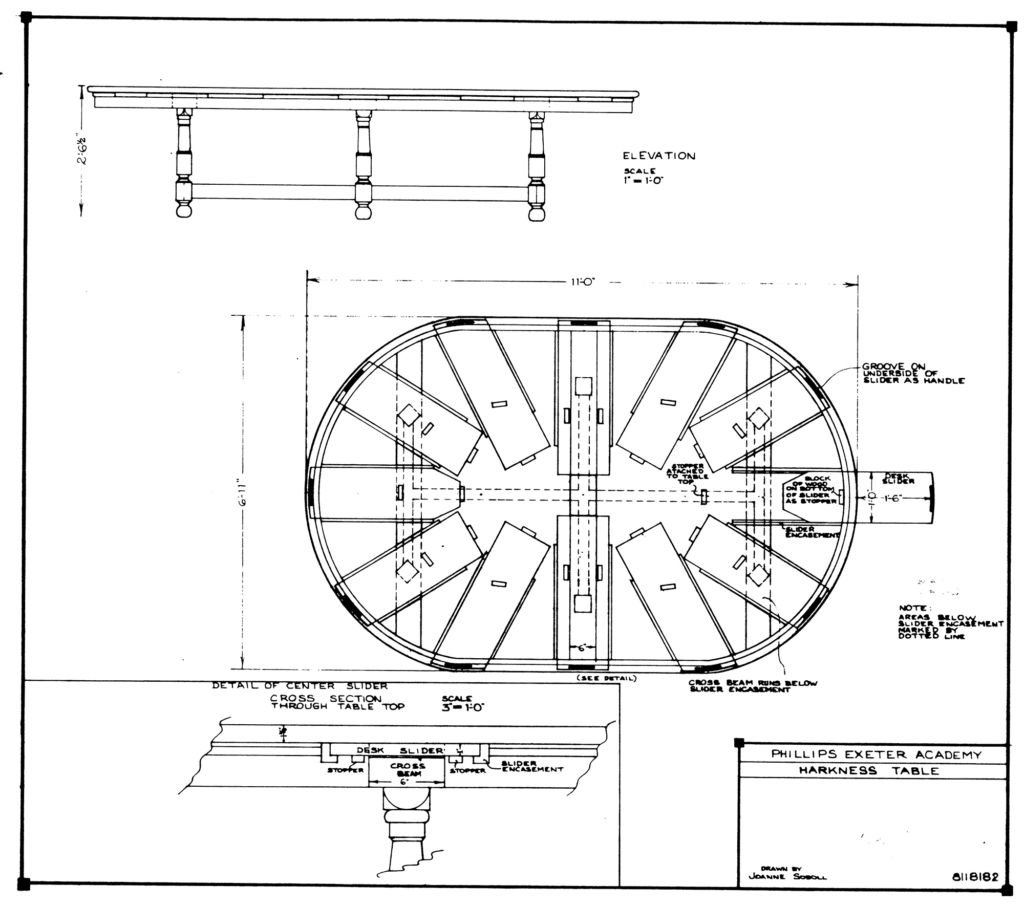
If you ask me, it feels like the education equivalent of King Arthur’s Round Table. It makes education feel more democratic and less about a teacher up on a pedestal reciting lines that students have to remember. It’s about mutual respect and valuing one another’s ideas. No wonder students are more likely to enjoy learning in that environment!
That makes it much easier for learning to stick in students’ heads. The more active you are in the learning process, the more likely you are to remember the key details in the lesson. And if you slowly come to understand a text together as a class, you’ll actually truly grasp what it means and be able to repeat the same skills in the exam when you need them.
The discussion process #
At Shani’s Tutoring, we regularly use the Harkness method in our classes for discussions. That’s because we have seen the value of it in improving student grades and helping them to think critically.
We have a clear process that we follow when we want to use these discussions in class. This helps us to make sure that each student is making the most out of their time with us and benefitting from the contributions of their peers.
It also reduces student anxiety. We know that it can be daunting to participate in class discussions about tricky texts and ideas. So, we factor this into our process by giving students lots of opportunities to prepare before the session begins. We also make sure to follow this process every time, so that students don’t feel taken off guard by a Harkness discussion.
This process involves some work from you as a student. So, we recommend that you have a read through how Harkness discussions work and familiarise yourself with the process.
During planning #
While the Harkness method helps to improve student grades massively, not every single moment of tutoring will benefit from discussion-style learning. That depends on each individual lesson. We have to consider the skills we’re focusing on and the types of information you need to learn. So, while we’re planning our group classes, we carefully consider when we should include these discussions and how long they should run for.
The first thing we do during planning is make a list of the skills and knowledge that we are trying to teach you. This then helps us decide what activities will be the most effective during each class. Harkness discussions are one type of activity, but we have plenty of others! For example:
- Live modeling, where the tutor shows you how to do something step-by-step and you follow along.
- A Q&A session to ask tutors your burning questions.
- Breakout rooms with group activities.
- Collaborative mind maps.
- Short 1-2 minute student presentations.
- Live, interactive quizzes.
We also factor in where students are in their learning journeys with us. We won’t ever expect you to do a Harkness discussion on a topic you’ve never seen before! We’ll always teach you the basics before we expect you to hold a discussion with other students. That way, we know you have the tools you need to do well.
Before the Harkness discussion #
We expect you to prepare for a Harkness discussion before you get to class.
Your tutor will post a document on the Learning Hub with the week’s inquiry topic. This document will be packed with information to prepare you for the discussion and can come in many different forms. For example:
- An unseen text for annotation.
- A section of a text we’re studying.
- An article from a critic.
- A review about a text.
- Multiple shorter extracts from different writer.
- A knowledge explainer sheet covering an important topic such as context, genre or critical theory.
How you prepare will depend on the document! If we’ve given you an unseen text or an extract from the literature we’re studying as a class, you should read and annotate it fully. For the information-based documents, you have much more freedom. You can scan for important details, focus on sections you’re particularly interested in, and skip parts that don’t resonate with you.
But we’re not trying to shackle you to these documents. They’re there to make discussions fair an equal by ensuring everyone has the knowledge to contribute. If you don’t know the topic well, just read the document and you’ll have everything you need. However, if you have extra information, please add it to the discussion! We always value each student for the unique things they bring to class.
It is your responsibility to make sure you’re prepared.
As well as the text, we’ll also provide you with some prompts to get you thinking. Plus, before the class starts, we’ll ask you to add at least one question or area of exploration that we can talk about during the Harkness discussion. Please make sure you’ve done this.
During the session #
Once you get into class, your tutor will begin with a Do Now. This will usually involve a Free-Write to help you apply the discussion topic to yourself and your own context. After all, the more connected you are to a text and the more it resonates with you, the easier it will be for you to get top marks.
Then, the tutor will explain what they expect from you during the Harkness discussion. This includes:
- Our rules for a fair and productive discussion.
- The types of contributions we’re looking for.
- How to show that you’re listening and engaging with other people.
We keep a list of our expectations here on the main website. Please feel free to have a look before the session starts, or even to keep it open during the discussion.
When your tutor has explained everything, they will ask a question to start the discussion off and take a step back. If you’re a particularly quiet group, they might choose someone to speak first. Otherwise, for our more experienced students, we expect you to start talking on your own for the most authentic discussion.
While the Harkness discussion is happening, the tutor will mark down who is talking, who they are talking to and what kinds of contributions they make. We use a special piece of software called Equity Maps for this.
At the end of the discussion, your tutor will make some general reflections about what went well in each discussion and how we can improve as a class. They might also show you what the discussion looked like on Equity Maps! It will show you information on who spoke to who and what kinds of conributions people made.
Finally, we’ll end the class with a written task to organise all your thoughts.
After the class #
After the class, your tutor will use the information they’ve gathered to inform how they’ll help the class more. They’ll update reports and add any personal comments to your Learning Plan. This is something that you or a Parent, Guardian or School Representative can export and read whenever they want, straight from the Learning Hub!
In the meantime, the next piece of written work assigned to you will be based on the Harkness discussion. Usually, it will be related to the discussion topic that the tutor introduced you to at the beginning of the session.
The point of this piece of written work is to consolidate your thoughts and new learning. You should now have a better understanding of the topic, so it’s a great time for you to record what you know and explore how the discussion has helped to shape your thoughts, ideas and arguments.
We’ll also advise you to look over the feedback we give you. That will help you to improve for the next session. Most of the skills you need to do well in a Harkness discussion are the same as the ones to get a high grade in your exams. So, reflecting on what you did well and how you can improve is a great way to boost your marks and get closer to your dream grade.
That’s why we often ask you to do a self-assessment of how well you did in the discussion. After all, you’re always going to improve the most if you combine feedback from your teacher with your own reflections on how you did. That way, if you just had a bad day one week, you know how to do better next time.
In your reports #
Thanks to the Learning Hub, you can always access your Learning Plan.
This is an automatically generated report that tells you the skills you’re expected to develop for your subject and level. It usually includes the subject’s assessment objectives, as well as some extra skills to master to get top grades.
When a tutor marks an activity you completed, your Learning Plan will update with the new information. It will tell you if you’ve passed that skill, and how well you did on it. You can export this information at any time! So, it’s especially useful for homeschool students who have to provide evidence of their education.
When we have a Harkness discussion, your teacher uses all the data that they gathered from Equity Maps to figure out what grade to give you. We reward you based on many different things. For example:
- How well you met the subject’s assessment objectives.
- Whether you contributed to the discussion or not, and how often.
- Valuing other people’s contributions as well, rather than just dominating.
- Addressing other people in a professional way, using their names.
- Building on or challenging other people’s ideas, rather than just introducing new ones.
- Asking good questions.
- If you’re talking to a variety of people.
Then, we bring all the information together to help us decide what grade we’ll give you. You’ll get an area that we think you need to improve on, too.
Since we have Harkness discussions quite regularly, you should slowly get a sense of your strengths and weaknesses over time. You’ll always know if we’re having one before it starts! So, the best students have a look over their goals and areas of improvement just before we jump into the next one.
How the Harkness method improves student outcomes #
The Harkness method has many benefits. The biggest one is that it mirrors the way experts of Arts or Humanities subjects think and argue, so it subtly trains you to get those top grades.
When done well, Harkness discussions improve your outcomes in many ways:
- Backing up your thoughts to your peers strengthens your arguments.
- You’re more involved in the learning process, so information sticks in your head better.
- You have to think for yourself more, so unexpected exam questions won’t throw you off as much.
- We adapt the exam criteria for our marking, so our feedback is always as useful as possible.
- We value you using your knowledge and experiences in the discussion, meaning it’s more authentic and fun.
- The lessons are more enjoyable and easier to understand.
- Your tutors have more time to give useful, detailed feedback.
- Shy people have time to prepare before the discussion, making contributing less scary.
- It trains you for university seminars.
- We mark you for your social and collaborative skills, helping with socio-emotional development.
- You’re in a safe space where you can make mistakes and improve important skills that you’ll need in the workplace.
Interestingly, we’ve also found that Harkness discussions are a huge help for neurodivergent students who feel anxious in social situations or occasionally miss social cues. That’s because we always reiterate the rules before we start and give students feedback on how well their discussions went. That way, we’re demystifying the discussion process and making it easier for people of all ability levels to participate.
Combined with all our other activity types, we see huge success with his method!
Harkness in online spaces #
In a traditional Harkness discussion, we;d be sitting arounf one of those specially patented tables.
However, most of our sessions at Shani’s Tutoring are online via Zoom. This means that we have to find ways to adapt the discussion to work well remotely.
In a good Harkness discussion, students speak to one another and show they’re engaged with the points their fellow students are making. You’d wait your turn to talk and be polite to other people by being silent for their turn.
In some ways, that’s easier online. We can mute when we’re not talking so that the speaker doesn’t get drowned out or distracted. However, being online also has its challenges. For example, it’s not nice to be the only person on camera during a discussion, or to feel like people have got other tabs open and aren’t really listening to you.
There are also extra things that we need to consider as tutors. We’re trying to teach you important communication and collaboration skills, and giving feedback is an important part of that. But if we’re not sure whether you were giving us your full attention or not, that could affect the feedback we give you.
That’s why we have robust policies, such as our Terms and Conditions and Community Code of Conduct. It’s mandatory to have your cameras on while you’re in a session. We also have rules about making sure that you use your mic only when it’s your turn to speak, and show respect for others. The biggest, most important rule is that we should always be hard on content, but soft on people.
We’ve found that Harkness discussions can work very well in our online space, as long as everyone follows the rules and participates!
Our expectations #
As mentioned before, we need to have some clear expectations to ensure our Harkness discussions work well. Ours are quite simple:
Before the session:
- Read and follow the Terms and Conditions, Community Code of Conduct and Guidelines for Harkness Discussions.
- Prepare for the discussion before the session by reading the document and making notes.
- Check your previous Harkness feedback and keep it in mind.
- Make sure your mic, camera and internet are working.
During the session:
- Arrive on time.
- Keep cameras on at all times, except in exceptional circumstances.
- Mute your mic when others are speaking.
- Stay engaged. Don’t get distracted by other tabs and apps.
- Speak to each other, not to the teacher.
- Take space and make space.
- Try to make at least one contribution per session.
- Don’t dominate discussions.
- Include other people who aren’t getting the chance to speak.
- Stay on topic.
- Don’t interrupt one another.
- Be kind to one another.
- Be hard on content, soft on people.
- Actively listen to other people’s points.
Other than that, Harkness discussions are supposed to be a fun way to learn. So relax! Enjoy!